
Best Practices for Preparing Media Files
To send a successful MMS message in ThruText, your media files need to meet specific size and format requirements. Whether you’re resizing an image or compressing a video, properly preparing your files ensures that they upload correctly and display well for your contacts.
This guide walks through best practices for editing, resizing, and formatting both images and videos to ensure your media uploads correctly and reaches your contacts. For additional context, check out these related guides:
TABLE OF CONTENTS
Media Requirements Overview
The Media Library allows you to upload files up to 10 MB. When you upload a file, it automatically undergoes a process called transcoding, which converts and compresses the file into a format compatible with MMS.
For a file to be sent as an MMS, it must be under 750 KB after transcoding. Depending on the original file's size and format, you may need to resize or compress it before uploading to meet these requirements.
Resizing Images
Most image files can be resized using built-in tools on your computer or free online editors.
- Resizing Images using Preview for Macs: Follow the directions on resizing images in Apple's Support guides: Crop, resize, or rotate an image in Preview on Mac.
- Open your image in Preview.
- Click Tools > Adjust Size.
- Check Scale proportionally.
- Choose a smaller pixel dimension (e.g., 600px width).
- Save the image.
- Resizing images using Photos in Windows: Follow the directions in this Business Insider guide: How to Resize an Image on Windows.
- Open the image in Photos.
- Click the three-dot menu in the top right.
- Select Resize > Define custom dimensions.
- Check Maintain aspect ratio.
- Save the image.
- Other tools for images: Free tools like Krita, Image Resizer, or GIMP can be used. You can also use a paid tool like Adobe Photoshop.
Resizing Videos
When you upload a video to the Media Library, it is automatically transcoded (converted and compressed) into a format compatible with MMS. While you can upload videos up to 10 MB, the video must be under 750 KB after transcoding to be sent as an MMS.
Recommended Video Length
Keep videos under 17 seconds to improve the likelihood of meeting MMS size and format requirements. Longer videos can be difficult to compress below the 750 KB file size limit.
If your video is too large, you can try shortening it or reducing its resolution using the tools below.
- Resizing Videos on Macs: Most Macs come preinstalled with a video editing software called iMovie. To compress a video in iMovie, follow these steps:
- Open the video by selecting File > Import Media.
- After opening the video, select File > Share > File. You will then be able to adjust the resolution, quality, and compression options.

- Export the video and save it as a new file.
- Resizing Videos on Windows: In Windows, you can download a free app from the Microsoft Store called ClipChamp. To compress a video in ClipChamp, follow these steps:
- Open the app, sign in, and click Try it next to Trim your Video.
- Add your video by clicking Add or drag and drop your video into the app.
- Click Export and select a lower resolution to compress the video to.

- The file should automatically save in your Downloads folder.
Video MMS FAQs
- What do videos look like to contacts?
To most contacts, the preview shows the first frame of the video with a clickable play button like in the image below. This can vary widely depending on the recipient's device.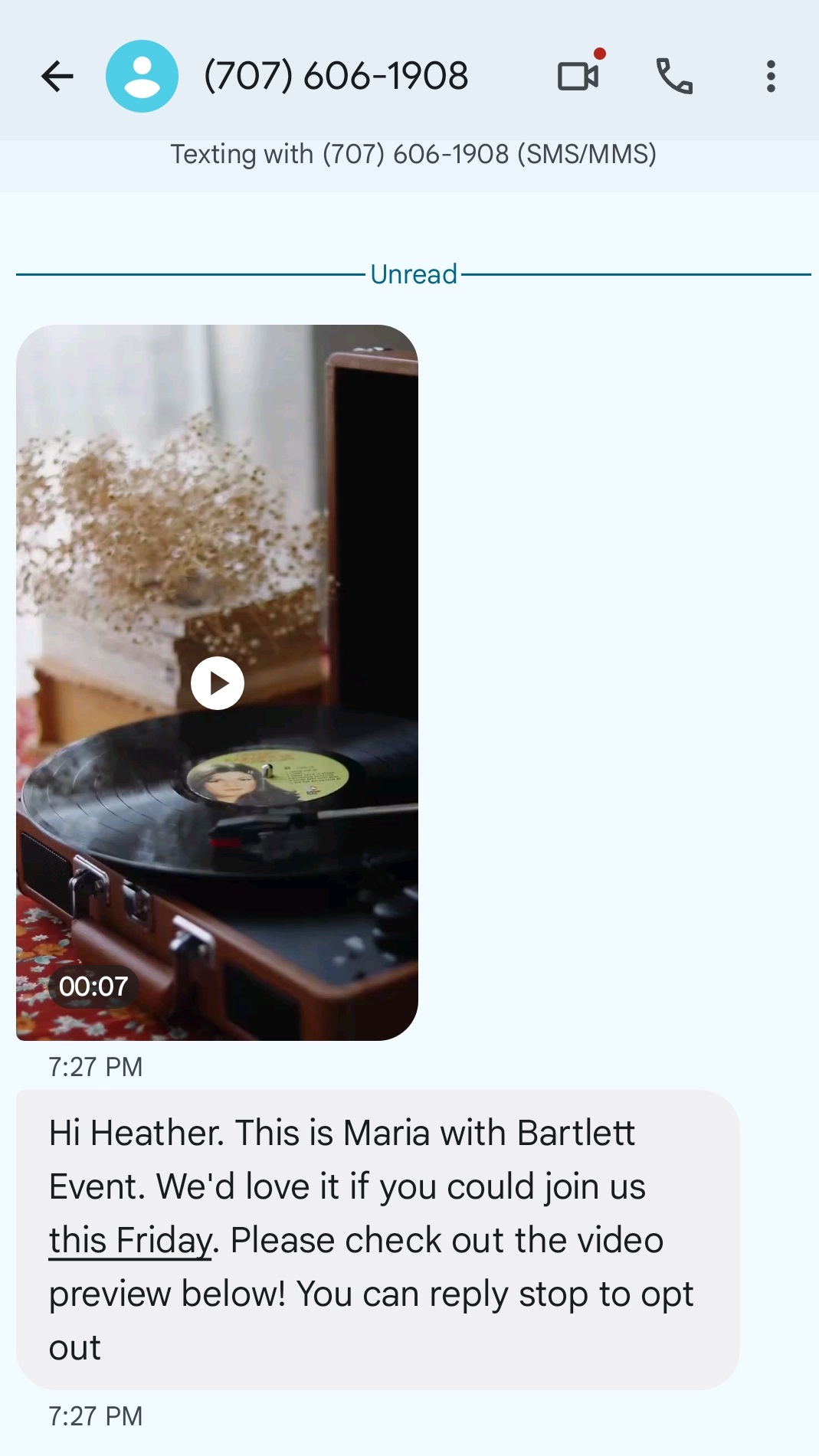 We recommend sending a test MMS to yourself before including a video in a larger campaign. Testing allows you to confirm that the video displays and plays as expected. You can also preview a video before sending by opening the file from the Media Library.
Some contacts may see videos as downloadable files, like in the image below, especially on older devices or if specific settings are enabled. This should not affect most recipients.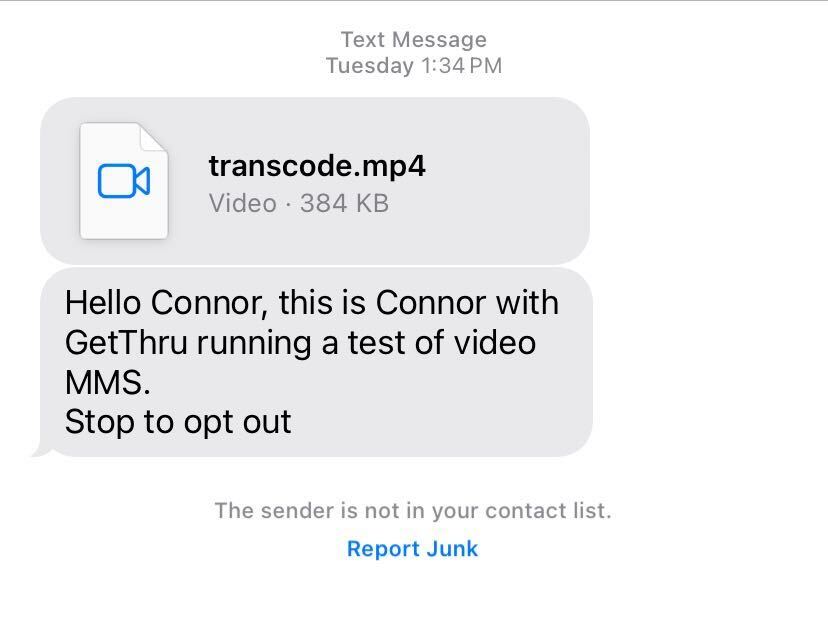
- Why is my video upload stuck?
Transcoding videos takes longer than transcoding other file types. If your upload seems stuck, wait a few minutes and then reload the page. - How can I share longer videos?
We recommend keeping videos under 17 seconds for MMS. If you'd like to share a longer video that cannot meet MMS size and format requirements, you can host it on a third-party platform like YouTube or Vimeo and share it using a Trackable Link. - What to do if your video is rotated?
Some videos uploaded to the Media Library can become rotated after transcoding. This can happen if the video resolution is stored incorrectly. For instance, if you download a vertical video from Google, the file may save as 1920px width x 1080px height rather than the intended 1080px width x 1920px height. If this occurs, convert the file to the preferred dimensions using a free online tool, such as Online Converter or Video Compressor. After re-uploading the corrected file to the Media Library, preview it by clicking the three-dot menu and selecting Open. - What is the recommended aspect ratio for videos?
Sending videos with a Portrait aspect ratio matches the natural orientation of most mobile devices. Videos with a non-standard aspect ratio can be pixelated more during transcoding. Use one of the following ratios for best compatibility:- Vertical (Portrait) - 9:16 (640 x 1138 px): This aspect ratio will work for most devices across different carriers. This prevents the user from needing to rotate their phone to see the video, and is the standard ratio for mobile friendly video content like YouTube Shorts and TikTok.
- Square - 1:1 (can vary, for example 400 x 400 px or 600 x 600 px): This ratio ensures compatibility across the most devices and carriers. Since this ratio typically contains less total pixels than 9:16 or 16:9, it's easier to keep these videos smaller in file size, making them mobile and carrier-friendly.
- Landscape - 16:9 (1,280 x 720 px): This aspect ratio is great for horizontally oriented videos. Remember to keep important content centered, as some devices or carriers may crop the edges.
- What frames per second should the video have?
The recommended FPS (frames per second) is 30 for best playback quality. Otherwise, keep video FPS at multiples of 15 to appear correctly on mobile devices (e.g., 15, 30, 45).